
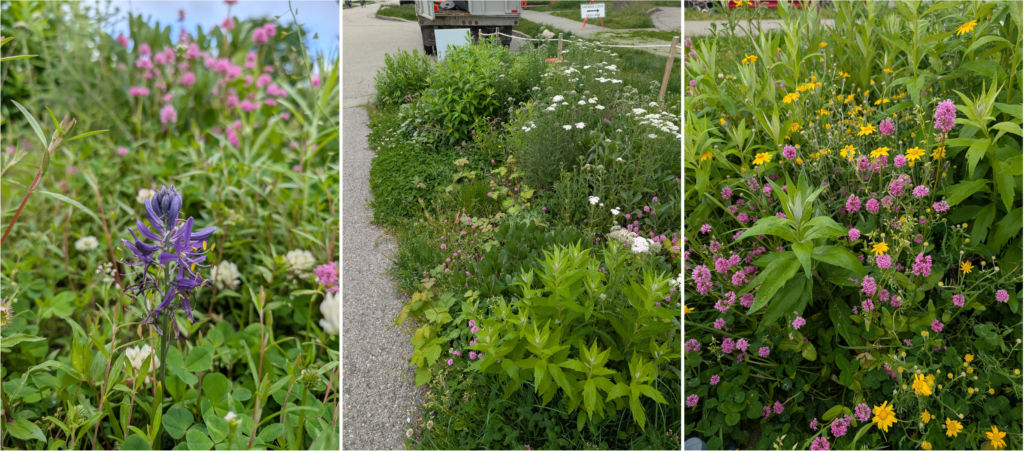
The second year at the Pt. Grey meadow was truly spectacular!
An overview of the all-native meadow at Point Grey is easy to summarize.
1) Very happy! What evolved and unfolded was dynamic, beautiful, and attracted bees, birds and humans alike.
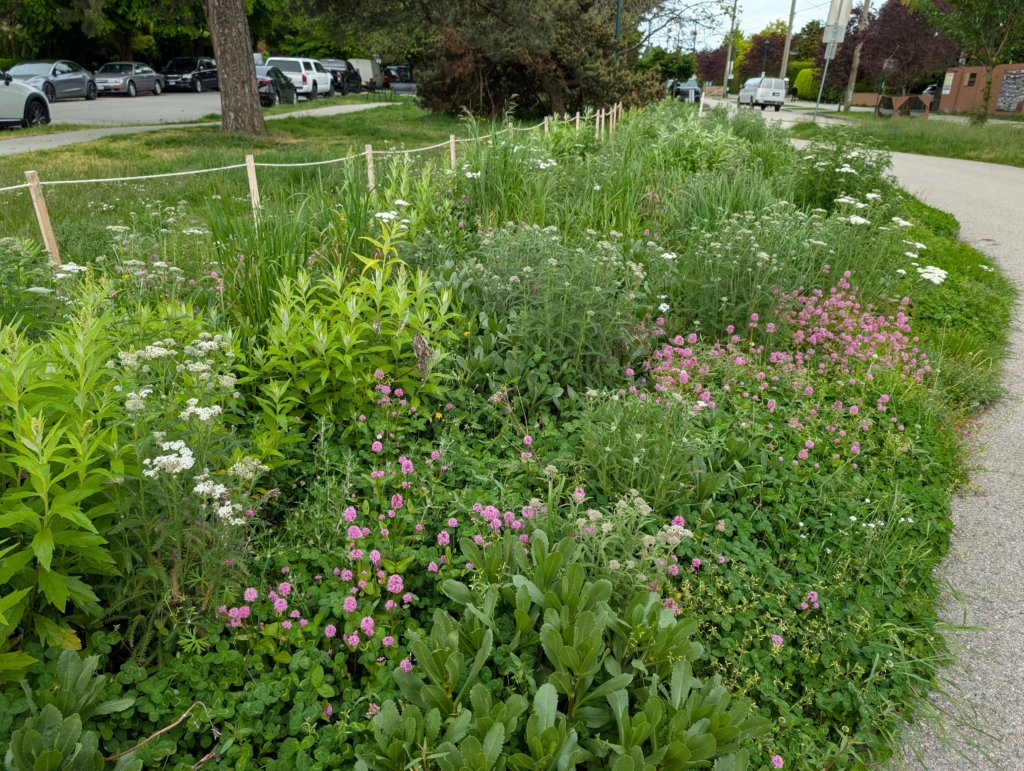
2) With its textures, accents, and composition, the meadow looks designed, yet it was only seeded. The meadow was established by hand-broadcast seed in February 2024. Yet, the structural diversity that emerged after 2 years hints of a carefully designed planting plan. Nature is clearly the BEST designer!
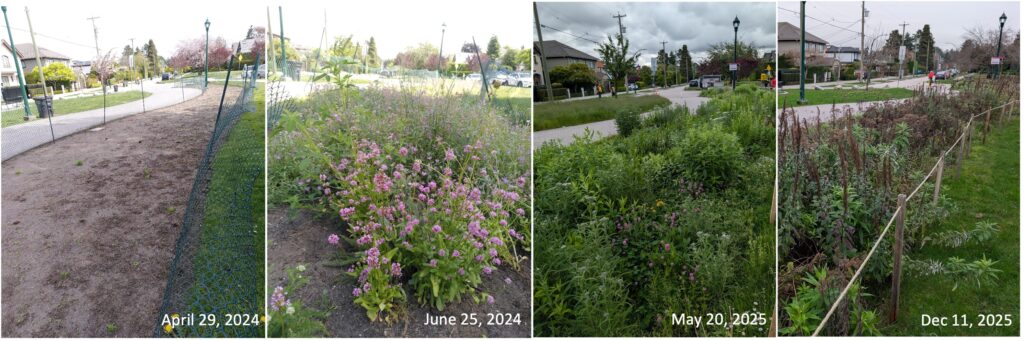
3) Carbon-negative. The plants for this 100 m2 meadow arrived by mail in a single bag of seeds. By avoiding nursery-grown plants, we avoided the equivalent of 1,440 and 4,000 liner plants/ pots, along with:
- the associated trays and pots (which are made of virgin plastic and NOT recyclable);
- the transportation (and emissions) associated with those plants;
- water, fertilizers and other inputs from nursery care.
In truth, we did actually put in some plugs/ pots in autumn 2024, to fill gaps from the removed volunteers (see bottom of Year 1 post). However, these were pulled up by crows! This is another reason we prefer seeding: not only do plants establish that are resilient in terms of developed root systems , they are less interesting to crow foraging behaviour. The image below shows one of many Cerastium arvense that were pulled up.
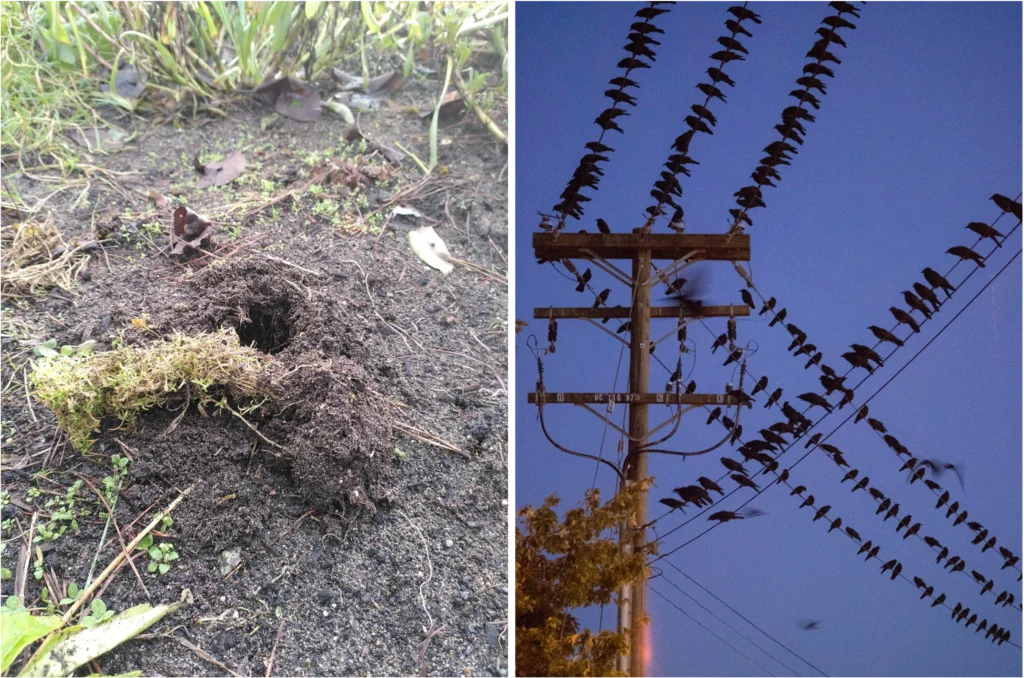
Plant damage from Northwestern crows is another reason to advocate for seeding, certainly in Vancouver. These intelligent corvids are accustomed to foraging in lawns (as chafer beetle larvae provide excellent nutritional value), so freshly planted plugs are easy targets. Crow damage can be extensive, which Christine experienced in 2019 when crows systematically undid her work every day on a green roof planting. Check out her essay, “Crows of Vancouver: Middle Path between Biophilia and Biophobia”.
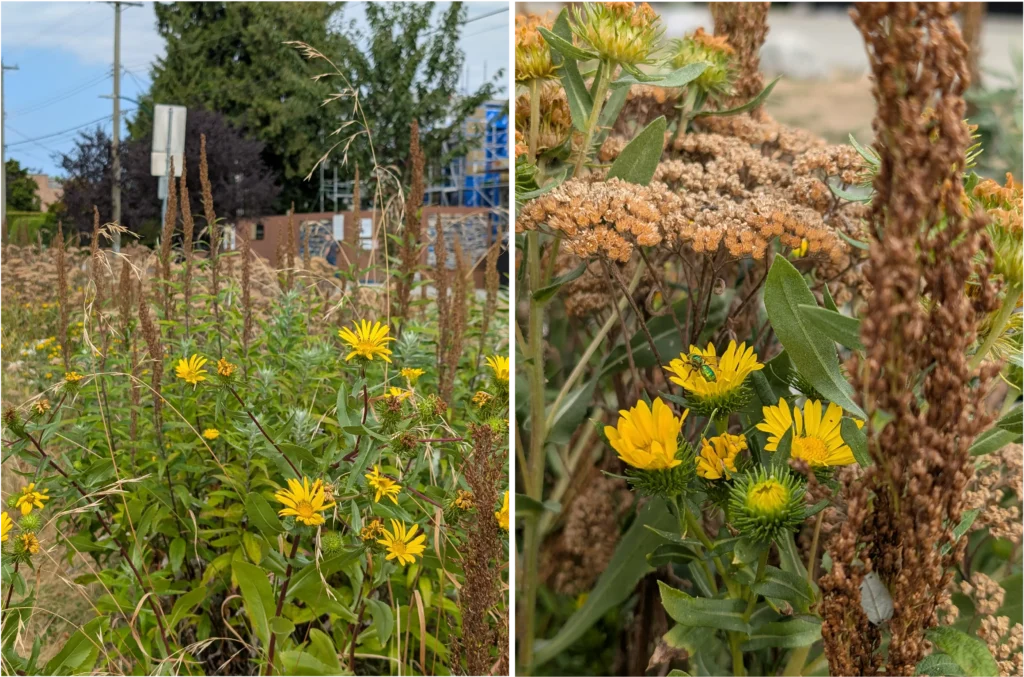
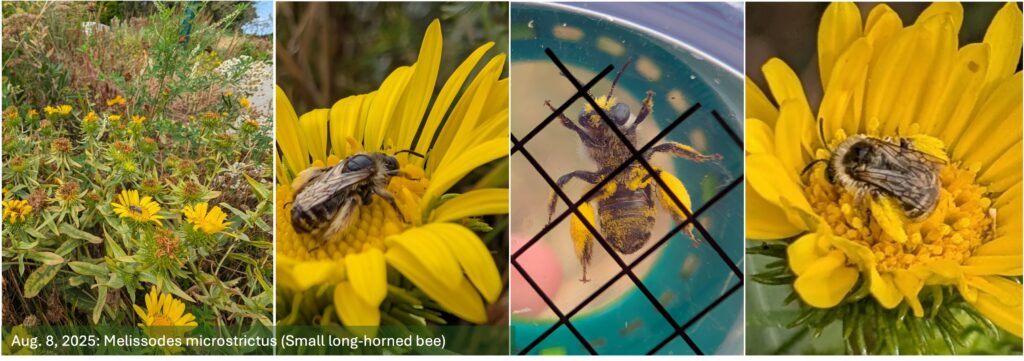
4) Never been irrigated, minimal maintenance only. Other than spot weeding to remove undesirable volunteers, the meadow did not receive any special care or attention. Perfect conditions for the species list! The gumweed did really well, with flowers into December! The images below, taken August 8th, show gumweed accompanied by coastal mugwort and yarrow (Artemisia suksdorfii, Achillea millefolium).
Species Highlights
The species list comprises plants indigenous to rainshadow habitats from regionally local ecosystems. In short, the species list is perfect for dry- to medium-dry sites, with full sun. Of the six species that didn’t appear in the first year, three appeared in 2025: Camassia quamash, Cerastium arvense, and Solidago lepida. The hemiparasite, Rhinanthes minor also showed up, as noted in our gleeful June post.
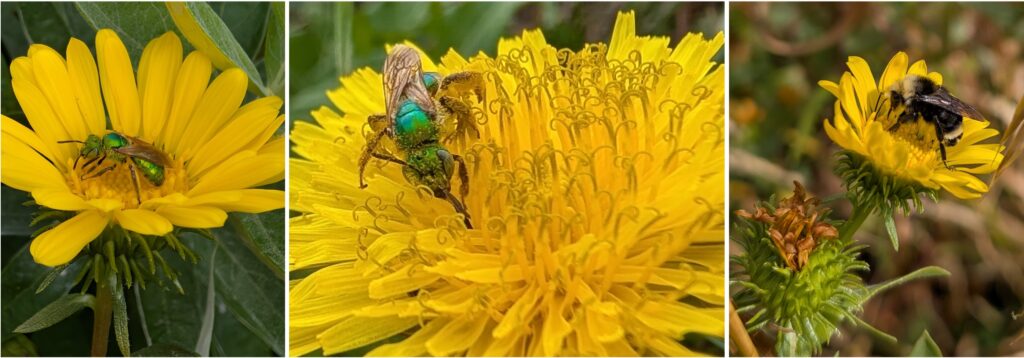
The meadow was visited by a beautiful assortment of pollinators. The fine striped sweat bee (Agapostemon subtilior) gave us a good lesson: In spite of all the gumweed (Grindelia stricta), she indulged in this dandelion for ages (see video), encouraging us to hold our judgement and accept this plant for its good qualities. Yellow-faced bumble bee (Bombus vosnesenskii) (image at right, below) was also a common visitor, as were the leafcutter bees (see video).
The small long-horned bee (Melissodes sp.) was another common visitor, who we often observed foraging on gumweed. Look at those pollen pants (below)! While this may be the most common species of Melissodes in BC, our iNaturalist post drew some important clarifications (from @beespeaker): “although M. microstictus may be the most common species of Melissodes in BC, it is difficult to ID with certainty from photographs. Thanks, Madame, good to know!
Since the plants chosen for this meadow are unique to this region, we want to keep the “cosmopolitan species” at bay. E.g., Shepherd’s purse (Capsella bursa-pastoris) is one of the most common plants on earth. An annual with a rapid lifecycle, it fills the seedbank and smothers other plants. Such species challenge the integrity of our intention, and so we did a couple weeding sessions (May and December).
Next steps/ Year Three
Our focus in 2026 is to ensure nesting habitat (in addition to healthy forage) for wild bees and and other beneficial insects. We will plan and implement maintenance activities that heed the ideal, as best we can.
Habitat for stem-nesting bees
With the biomass fully matured, we can now create natural stem-nesting habitat. The graphic below (adapted from Xerces) shows how the timing of maintenance activities can align with the life cycle of stem-nesting bees. (Check out Xerces’ free download, Save the Stems.)
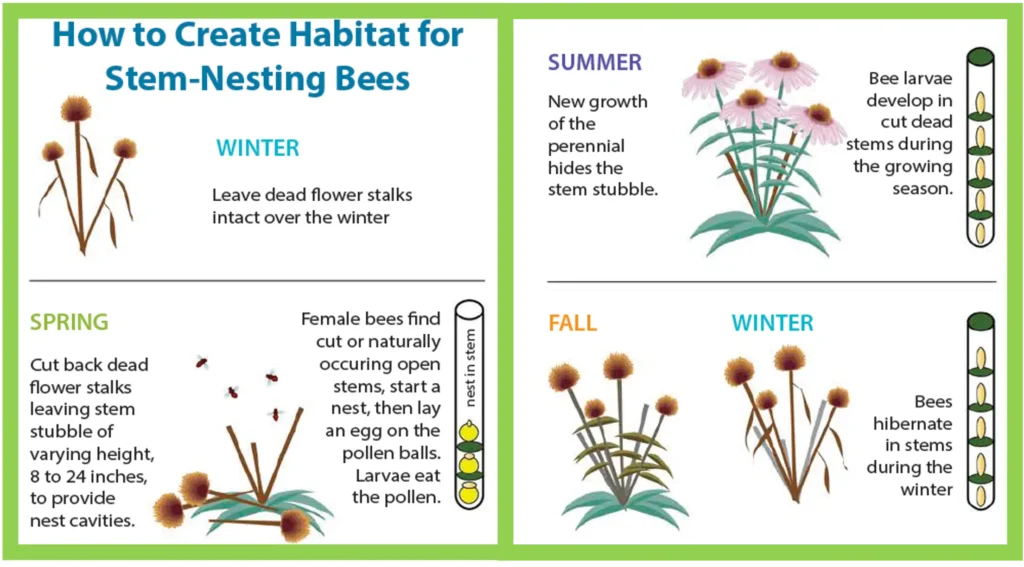
This means we’ll cut back the dead flower stalks in the spring, 8-24″ above ground, right before the first spring bees emerge. This will be early real estate, for next year’s generation of bees.
Habitat for ground-nesting bees
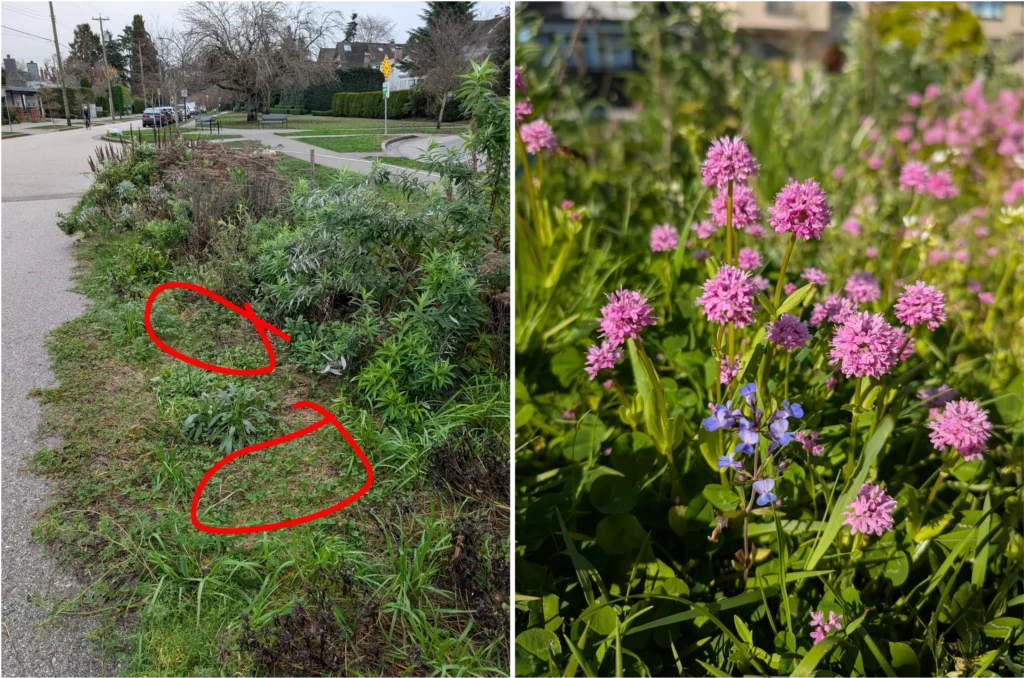
Ground-nesting bees need accessible soil and patchy vegetation. In December 2025, we put some time into removing densely vegetated patches of undesirable volunteers (creeping buttercup, red clover, vetch, chickweed, creeping bentgrass), with the aim of opening up the thatch and smothering biomass (red, below). We put down 50L of clean soil and re-seeded it with sea blush and poverty oat grass (Plectritis congesta, Danthonia spicata). Sea blush will germinate over the winter, creating a living mulch to protect the soil, and will be among the first to flower come May (together with Collinsia, below).
Proud Meadow Momma
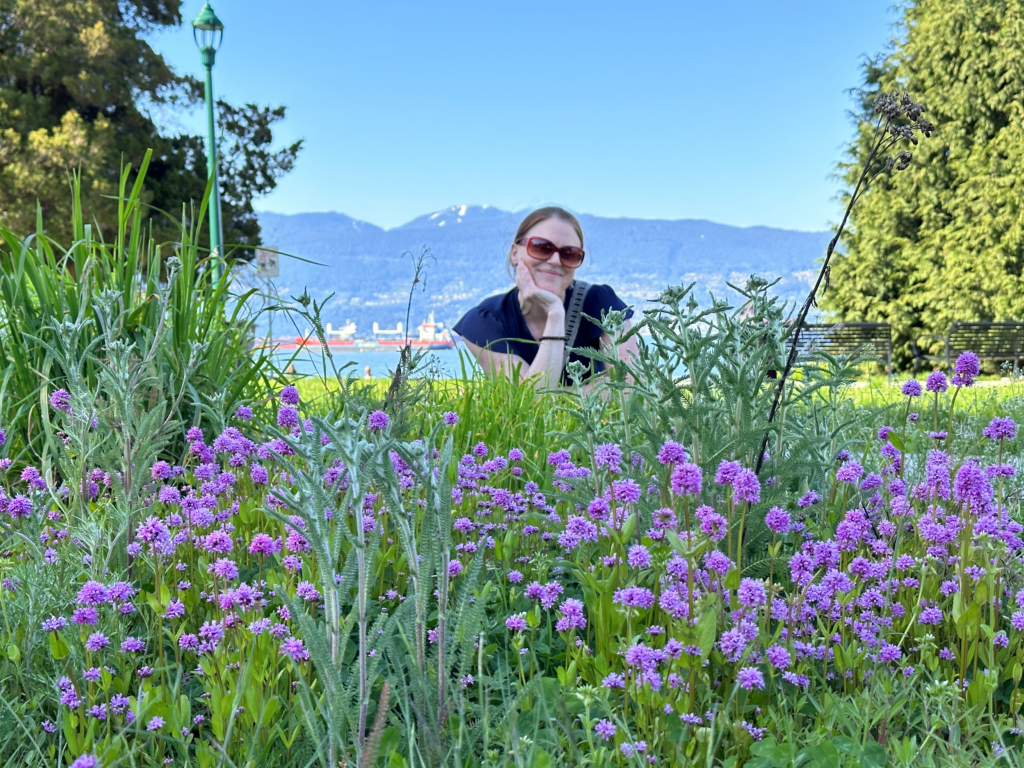
If you made it this far, thank you for your interest in this meadow adventure! We love hearing from you, so please leave a comment below if you feel inspired. Did you learn something new? What excites you the most? If you’d like to collaborate or invite us onto a project, please contact us. Many thanks to Goya Ngan for this lovely photo of Christine in May 2025, glowing like a “proud meadow momma”, together with sea blush, yarrow, California brome, and other flowering friends.
6 thoughts on “Kits Pollinator Meadow: Spectacular Season 2”
So inspiring! Really appreciate the detailed info and gorgeous photos. Congratulations on this project!
Thank you very much, Lorraine! I’ve been a big fan of your work since I got started (with Tallgrass Ontario!).
Thank you so much for this great news story plus how-to information embedded! So happy to see this work in action.
Thank you, Kim, we’re happy to see this work in action, too 🙂 Glad to be a Regenerative Practitioner with you!
Bravo for a beautiful project! Wow, the meadow looks amazing since we saw it in April 2024! I remember helping you monitor the tallgrass prairie that you created in that old gravel pit, near Petrolia, Ontario. Christine, I’m your biggest fan!
Aww, herzlichen Dank! Yes, that was such a neat restoration project, testing different plants and cover crops. In the meantime, that site has become a conservation area! I was fortunate to work with Mark Browning from the Ministry of Natural Resources on that project, who I learned so much. Merci viel mal, bisch e Liebi!
https://www.scrca.on.ca/portfolio/marthaville-habitat-management-area/