
Through experiential learning, participants of our “Meadow Work Bee” on March 22 implemented best practices, and created habitat for next year’s stem- and ground-nesting bees.
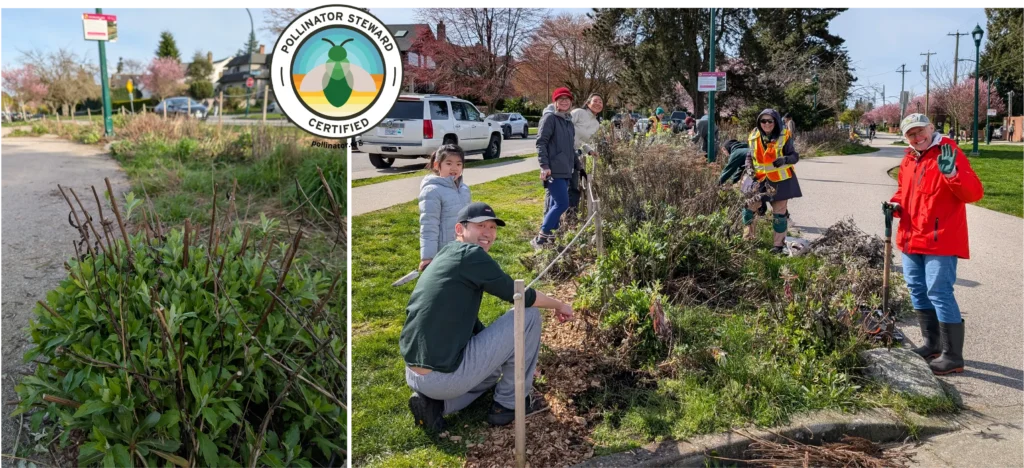
What better way to celebrate the Equinox than creating habitat for wild bees? This workshop was designed for experiential learning, in the spirit of “learning by doing.” To deliver experiential understanding on how to integrate native bees’ life cycles into garden/ landscape maintenance, Meadow Work Bee participants:
- learned about native bees and their life cycles
- implemented best practices in meadow maintenance
- built new habitat for stem- and ground-nesting bees
Early Spring + Year Three = Start of Long-Term Stewardship
Whereas Years 1 and 2 (2024, 2025) were this meadow’s establishment period, Year 3 officially marks the start of long-term stewardship. While establishment maintenance is basically preventing aggressive volunteers from establishing, stewardship maintenance involves removing biomass (burning, weeding), re-seeding annuals if they drop away, adjusting plant proportions as desired, etc. In terms of seasons, early spring is a great time to create new nest sites before the first bees start flying. Check out this sweeping video of the day.
Many thanks to the City of Vancouver for supporting this workshop, and for making it available to its volunteer green thumbs (Green Streets, Seeding Stewardship). The Meadow Work Bee wasn’t widely promoted, in order to give priority to that audience. Even so, the workshop was blessed by a local friend (Lisa lives a couple houses away), a conservation biologist colleague and fellow bee lover (Pamela), and a young family who saw the EventBrite for the brief moment it was public! Together, we co-created a fabulous afternoon and got SO MUCH DONE!
Top Questions Answered:
How to choose the best plants, specific plants, or guilds for wild bees?
The simple answer: native plants are best for wild bees. According to the Native Bee Society of BC (NBSBC)
“Native bees and native plants evolved in mutual relationships with each other over the last 100 million years. Specialist bees rely on specific plants to supply the pollen needed to feed their offspring. Generalist species can use many plants, and will also benefit if specialists are cared for.”
Check out these NBSBC resources:
- Forage Resources for Specialist Bees in BC
- Native Plants for BC Bees and Gardeners
- Seasonal Forage Guide
Gardeners’ Conundrum: Muck around vs. Let-it-be?
Wild bees spend much of their lives in non-adult form (larva, pupa), so there is always a chance that gardeners happily mucking about may unknowingly destroy bees-to-be. The simple formula around this is the RULE OF THIRDS: keep 2/3 of the area “wild” (or 1/3, if humans have higher priority).
To Weed or Not to Weed (and what is a weed, anyway?)
Last summer, a fine striped sweat bee (Agapostemon subtilior) taught me a lesson. The gumweed (Grindelia integrifolia) was peaking in floral fireworks all over the place, yet this gorgeous green bee took her sweet time on a dandelion. I couldn’t pull it! On March 22nd, there were only a few flowering plants at the meadow and, yes, they were ALL DANDELIONS. What to do!? Do we pull them? Leave them?
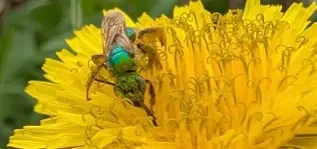
In the end, we left some of the dandelions, and pulled a bunch, too. This was partly because our youngest volunteer, Aria, was too small for cutting things but very keen to pull things out of the soil. It was also partly because I don’t want dandelion to get too abundant, not above-ground nor seedbank. As the steward of this meadow, I want to encourage the species that were sown. By extension, this means discouraging undesirable volunteers, especially cosmopolitan or invasive species.
Meadow Work Bee Accomplishments
The Meadow Work Bee accomplished SO MUCH thanks to our stellar participants! Never doubt what a handful of committed people can do, especially those who enjoy gardening. Everyone seemed very happy, regardless of the task. Work Bee is synonmous with the proverb, “Many hands make light work”. After talking about the wonderful world of wild bees and insect life cycles, we got to work.
Biomass Removal & Cavity-Nesting Habitat
We started by cutting down tall stems and dead flower stalks, which had been intact over winter. Coastal sage (Artemisia suksdorfii) can get tall and floppy, and Kristen from Satinflower told me its pithy stems are used by stem-nesting bees. As such, we cut those stems to between 8-24” above the ground. This had the double benefit of tidying up the meadow and keeping it off the bike path, which gives a “cue to care”, confirming that the meadow is intentional (NOT a neglected mess).
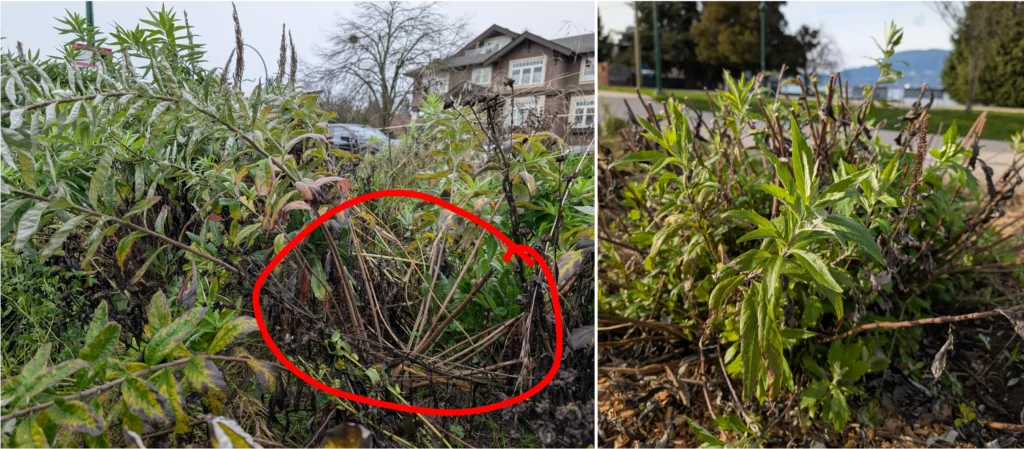
In some cases, the dead flower stalks of yarrow (Achillea millefolium) and gumweed were cut similarly to the coastal sage. The goal: to create vertical nesting opportunities in a variety of diameters, suitable for insects of different body sizes. Cut material was sorted into piles, and the nicest stems bundled together and laid horizontally along the meadow’s edge. Bees can still emerge as long as the stems are not compacted or sent to compost! The horizontal stems are on the bark mulch edging, and add to the “cue to care” impression.
Biomass Removal & Ground-Nesting Habitat
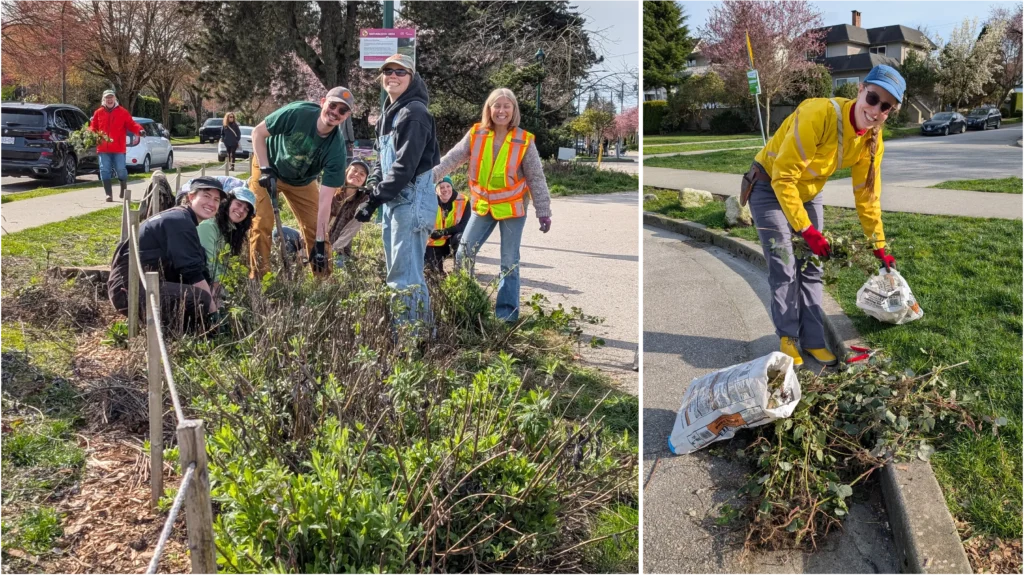
With vertical biomass tidied, we turned our attention to the ground. For clarity, the ideal maintenance would be a prescribed burn, which is supremely efficient in so many ways. Since that is not possible here, we removed biomass with human labour and tools, and sent it to green waste compost. Inevitably, Himalayan blackberry (Rubus armeniacus) has found its way into the meadow, and I’m extremely grateful for the efforts that went into removing as much of it as possible. THANK YOU, MEADOW WORK BEEPLE! The photo at right shows Marie packing up the blackberry biomass that was removed.
Grand Finale: Sand piles
Diversity of soils and topograhy bodes well for plants diversity AND ground-nesting bees. The Meadow Work Bee’s final activity set up an experiment to a question: Will ground nesting bees colonize sand piles? First, we selected areas where certain undesirable volunteers were creating dense thatch (bent grass, chickweed), and removed as much as possible. Then we laid down piles of sand, in mound formation with the deepest depth at the centre. This was inspired by my friend, John Little, whose sand pile was thoroughly colonized by ivy-mining bees when I visited him with our friend, Dusty, in Sept. 2024 (see Dusty’s silly video). For an overview of John’s bee-utiful, buzzing landscape in Essex, check out this video. Dusty and John are big advocates for solitary bees in England. They are lovely chaps, and lifelong learners, too, just like me!
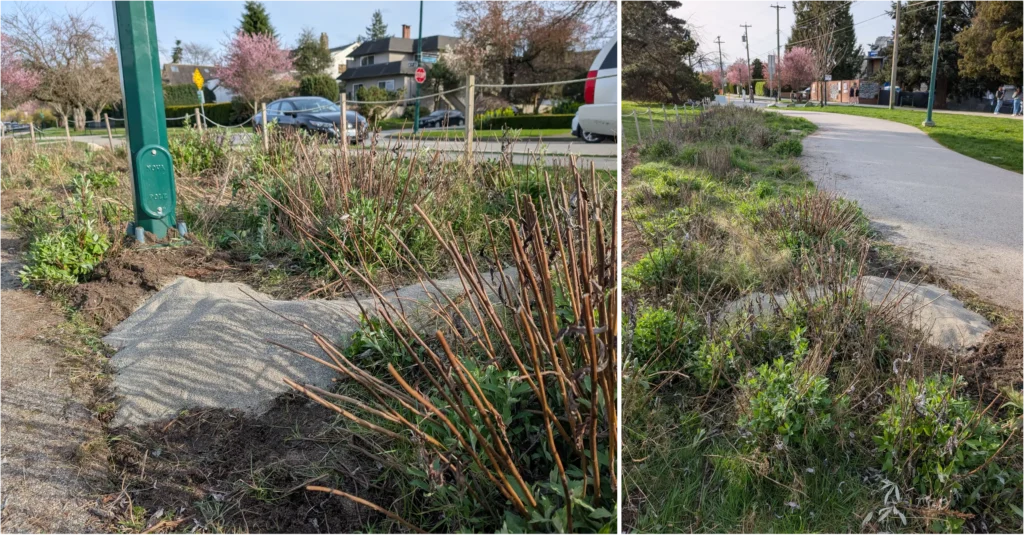
What kind of sand do ground-nesting bees need? Free of chemical contaminants, for one. We also wanted sand that can pack well, such that bees could in theory create burrows. As such, we avoided fine “play sand,” which is too loose, and went with a sharp sand that is used as a base for flagstone, pavers and shower. (Please keep an eye on this as time passes and let me know if you see any activity!)
Ready for Year Three
Thanks to the Meadow Work Bee, the Point Grey meadow is on good form for the year(s) ahead. May it be as floriferous and colourful as in the last two years! May it provide nesting habitat for wild bees, and support generations to come. May it bring joy and positivity into all who come across it.
If you happen to pass by the meadow, please stop and observe. I’m away from April through July, and would be extremely grateful for your photographs, too! If you use iNaturalist, consider adding your observations to these two projects:
- Toyota Pollinator Friendly Places: This project was sown with native seed funded by a Pollinator Partnership grant with Toyota. This site is one of 20,617 acres of quality pollinator habitat across North America since the program started in 2021!
- NBSBC Bee Tracker: Your pictures of bees in BC could have real impact, especially if they capture the right details.
Moving forward, we will refer to this meadow as “Musqueamview meadow”, as it’s at the foot of the recently renamed Musqueamview (šxʷməθkʷəy̓əmasəm) Street (formerly Trutch). This renaming (in June 2025) is a significant milestone in Vancouver’s reconciliation journey: Musqueamview/ šxʷməθkʷəy̓əmasəm is Vancouver’s first street name in hən̓q̓əmin̓əm̓, Musqueam’s traditional language! Learn more about this, and how to pronounce it, here.
All my relations! If you made it to the end, please leave a comment, we love hearing from you!
4 thoughts on “Meadow Work Bee 2026: Learning by Doing”
A wonderful summary of the day, Christine! I’m so grateful to have been a part of it! Thank you for organizing us, and especially for sharing your wealth of information about bees and what they need to thrive.
I didn’t realize we had over 500 bee species in B.C. – and an even bigger surprise, is that the majority of them are solitary, and nest in tunnels (say, wood or plant stalks – like the ones we left still standing) or in the ground (hence the pouring of jointing sand)! We also got a reminder of how vulnerable these amazing creatures are. For example, if a bee is dependent on a particular plant, the loss of that plant in their habitat means that bee is no longer found in the area.
My favourite moments at the meadow were seeing all the happy faces: genuinely happy to participate in such an important task as preserving the best parts of this bee paradise. The first and biggest dandelion was pulled out by our youngest gardener (seen in photo above). Even people who initially said they “don’t know anything” or “I’m not a gardener” were demonstrating the opposite! Even a little knowledge goes a long, long way. Just like this meadow; a small chunk of turf, but doing very, very large things!
A huge shout out to my fellow Blackberry-Busters!! It may feel like pushing snow uphill, but we made a definite dent in their spreading!
Lisa
(Green Streets Volunteer, Fairview)
Thanks, Lisa! Your energy, curiosity and skills were perfect for this workshop. I’m so glad you could join us. Special thanks for championing the blackberry busting, you’re a superstar!
Sorry we couldn’t stay longer was a lot of fun!
thank you for writing such a beautiful and informative summary of the day, and for sharing so much native bee knowledge! this was the highlight of my weekend. can’t wait to see the meadow bloom this year 🥰