This post honours Dr. Nigel Dunnett, who played an important role to many young designers and researchers, including Ecotone founder, Christine Thuring.
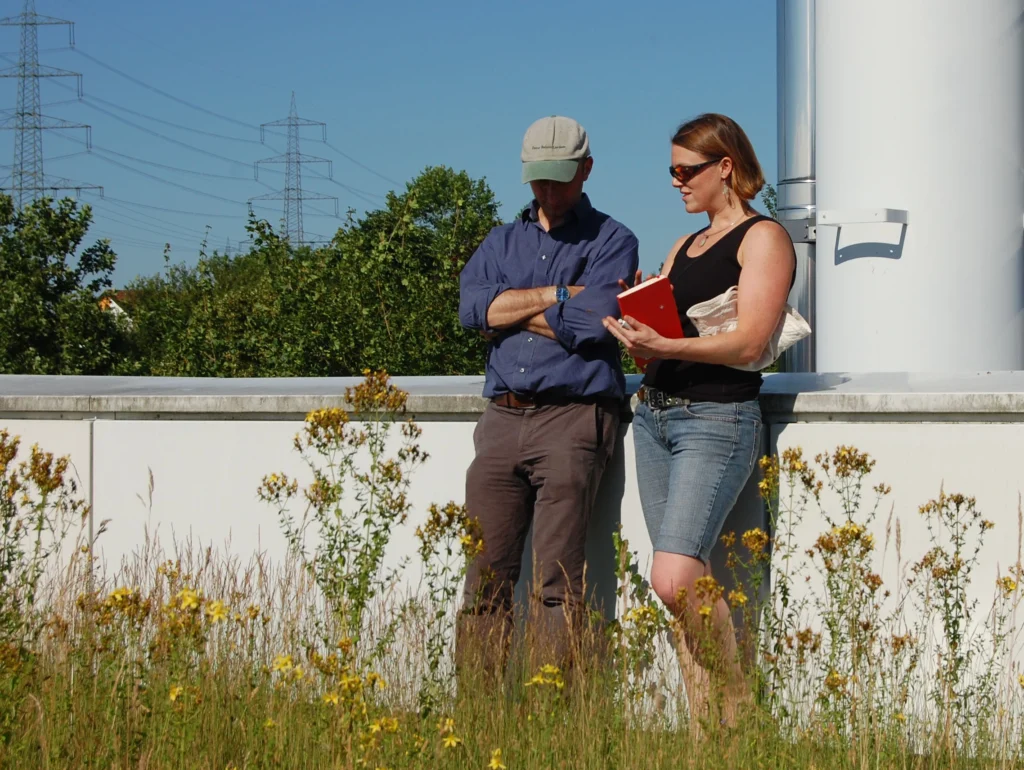
It’s my honour and sorrow to commemorate the life and contributions of Dr. Nigel Dunnett, who passed away at the end of April 2026 from extended illness. To Nigel’s family and those feeling his loss most acutely, please accept my sincere condolences. This blog post reflects on my ten years working with Nigel in Sheffield, with recollections on how he challenged and inspired me; his contributions to my growth and professional development; and what I wish to move forward. Life is short, after all! Please note, also, that you’ll find a treat at the very end of this post, so scroll if you need to (it’s worth it)!
(I also curated a commemorative piece for Greenroofs.com in August, which brought together lovely contributions from various people who worked closely with Nigel, notably Virginia Stovin, Ayako Nagase, Tobias Emilsson, Maggie Fennel, and Linda Velazquez).

Image credit: Greenroofs.com
Nigel Dunnett Career Highlights
Nigel Dunnett had a distinguished 30-year career at the University of Sheffield, where he was Professor of Planting Design and Vegetation Technology in the Department of Landscape (now the School of Architecture and Landscape Architecture). His visible impacts can be seen locally, nationally, and internationally.
In the decade that I worked with Nigel, his professional design practice was taking off. He won several prizes from Chelsea Garden Show, and delivered on numerous high profile, award-winning projects. In 2023, Nigel was awarded with the highest accolade for designers in the UK, “Royal Designer for Industry,” which recognizes individuals of sustained design excellence, whose works present aesthetic value and significant benefit to society. He also received a lifetime Fellowship of the Royal Society of Arts (RSA). See more about his design work here.
Christine’s Reflections: Research Lineage and Design Studio
Nigel was my PhD supervisor at the University of Sheffield (2009-2016). I also worked alongside him in the Department of Landscape design studios as a studio tutor, bringing ecological consideration to the design processes of undergraduate and Master’s students in Landscape Architecture. While his support as a research supervisor was ‘light-touch’, working with Nigel inspired a very creative phase of my career.
Lineage of research and ecological theory
My PhD was nested within a broader project funded by the EU Marie Curie Industry-Academia Partnerships and Pathways scheme. The research involved three field seasons based at the ZinCo headquarters in Germany, where I sampled the vegetation and soil of some of the world’s oldest extensive green roofs. This work aligned closely with ZinCo’s desire to understand how the plant communities and substrates on these roofs had evolved over time. Green roof ecology and long-term vegetation dynamics spoke directly to Nigel’s and my shared interest in ecological processes—a focus that closely mirrored his own doctoral research under the supervision of Dr. Phil Grime.
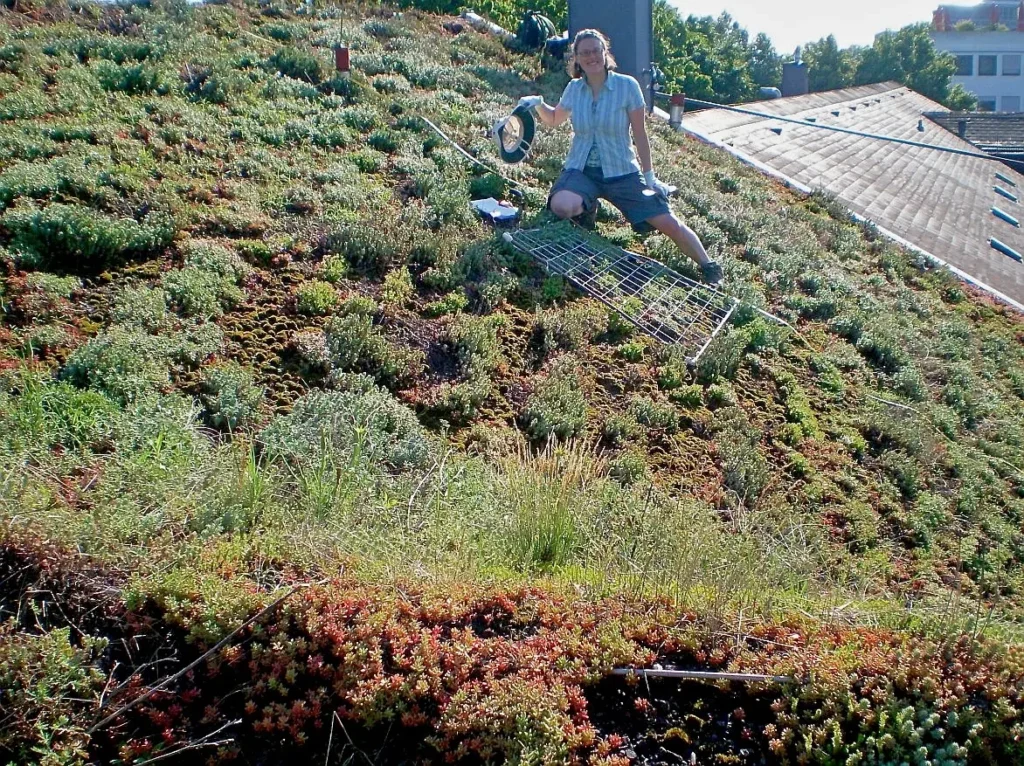
Using the classic tool of applied plant ecology, I sampled the vegetation and substrates on some of the oldest extensive green roofs in the world. Thanks to James Hitchmough, who helped build my quadrat!
My research used CSR theory (i.e., adaptive life strategies) to group and analyze my plant data. I’m pleased that my research is part of the Grime lineage, through Nigel. CSR Theory was hypothesised by Dr. Grime in the 1970s, and remains one of the few ‘unfalsified’ ecological theories of its time. Put simply, CSR observes that natural selection pressures have led to the evolution of adaptive life strategies conforming to distinct habitat types, whereby:
competitors (C) exploit conditions of low stress and low disturbance;
stress-tolerators (S) exploit high stress, low disturbance habitats; and
ruderals (R) benefit from low stress, high-disturbance situation.
CSR was a useful lens for my research questions. (Most species of the European and UK flora have been assigned CSR signature, which is not the case for American flora hence this system is not commonly used here). The concluding chapter of my thesis proposed a model for plant species assembly using CSR theory (also known as Universal Adaptive Strategies Theory).
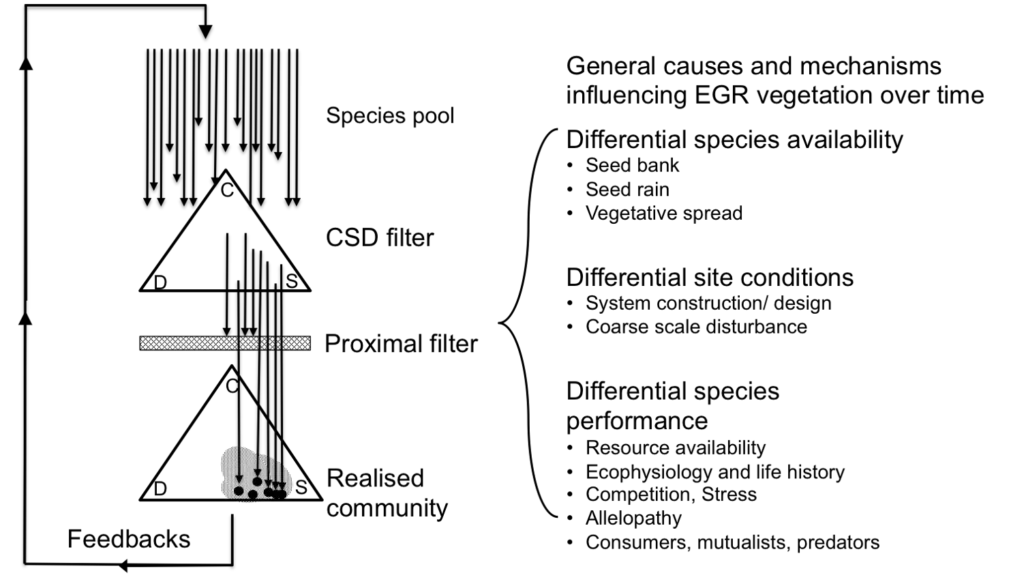
The model illustrates the general causes and mechanisms that influence the vegetation of extensive green roofs over time. The realised plant community is a result of species surviving filters, depending in part on their performance under the pressures of competition, stress, and disturbance.
Design studio, ‘Sheffield School’
When Nigel invited me to work as a tutor in the Department studios, I was confused. I told him, “I’m an ecologist, without any design training. What can I possibly offer?” He smiled and suggested I give it a try. Turns out I loved it! What a joy to bring ecological understanding into this creative space, to guide students on the design brief, which always included biodiversity and urban ecology. Students were encouraged to weave their impressions from field trips into their design work, too. For example, the straight lines from the old quarry at Padley gorge in the Peak District, combined with the spontaneous vegetation and craggy rocks. evokes the naturalistic aesthetic that the ‘Sheffield School’ of planting design is famous for.
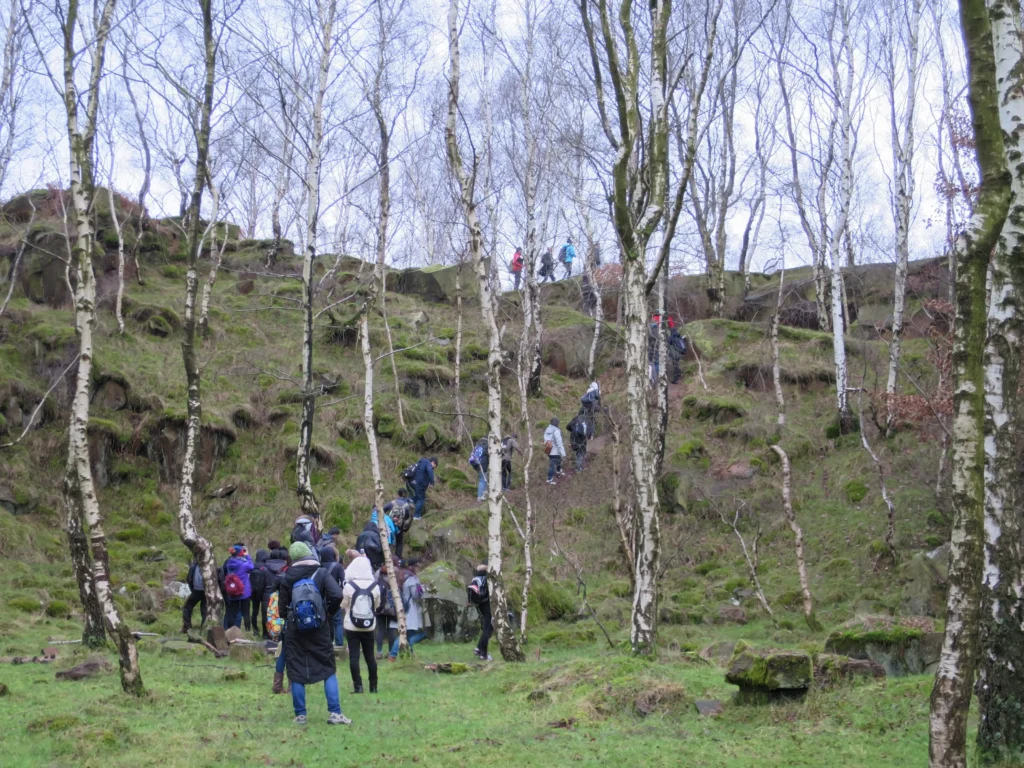
Padley Gorge, near Grindelford, is popular with hikers, climbers, and… landscape architecture students!
Nigel’s courses always used local projects, sometimes collaborating directly with landowners to generate constructive design ideas. My favourite is the award-winning Grey to Green scheme (bringing colour and sustainability to inner-city Sheffield), which engaged three cohorts of Master’s students to prepare design ideas for the City of Sheffield. With reference to approximately 250 proposals illustrating water-sensitive, wildlife-considerate designs that are equally aesthetic and functional, the City of Sheffield successfully secured EU funding to build “the largest grey to green conversion in Europe”. Phase 1 was completed in 2016; Phase 2 in 2022.
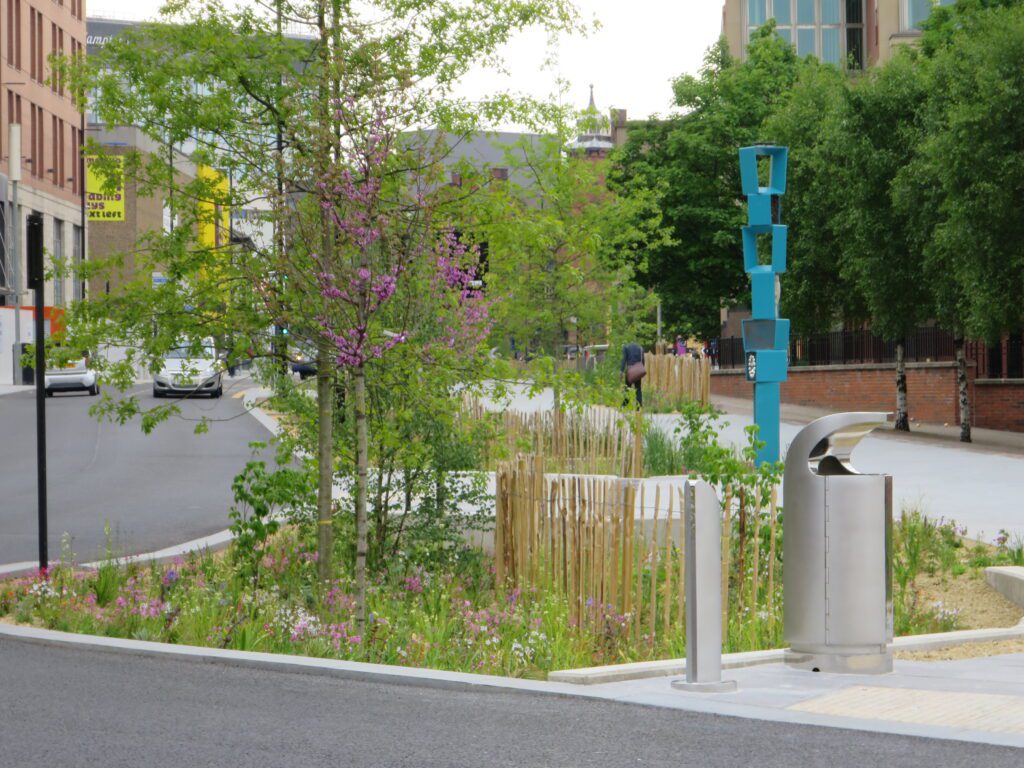 ‘Grey to Green’ transformed two redundant lanes of traffic into a corridor of rain gardens and meadows.
Moving forward: Urban ecology and naturalistic design
Nigel’s passing is an important reminder that life is short. In fact, I had a strong dream about him at the exact time he died (April 28), though I wouldn’t know for several months. I was two weeks into an 11-week retreat on a mountain in Spain, totally off-grid. The dream left me with a deep sense of remorse that I hadn’t honoured the relationship, especially as I’d known he was unwell. I resolved to reach out when I came off retreat. What a shock to read the news of his passing when I came off the mountain in July, and to realize that he’d passed away at the same time as the dream.
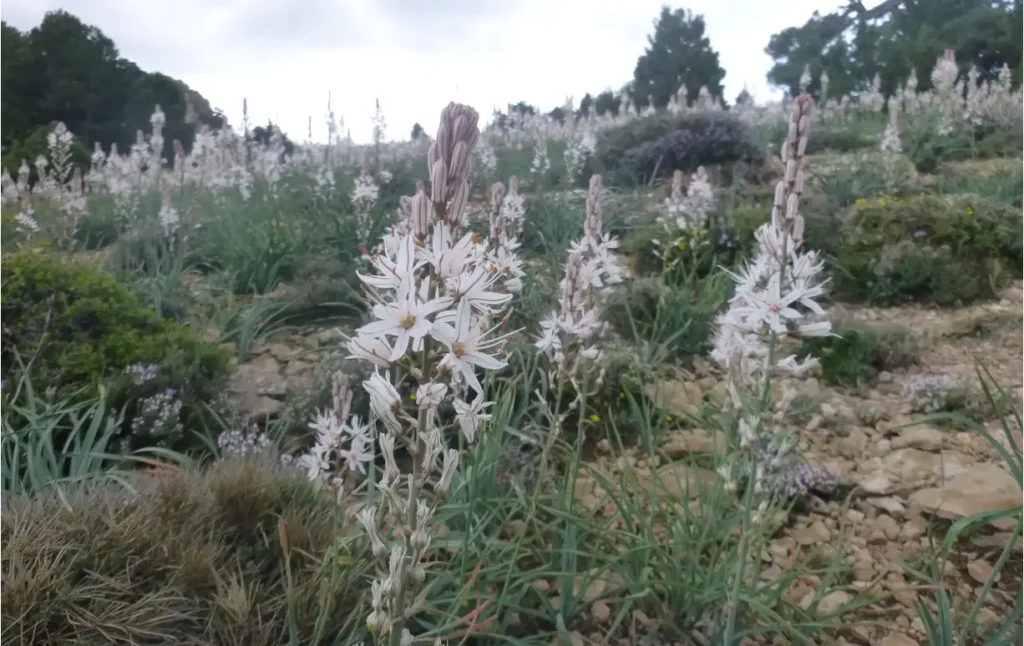
This meadow of white asphodel (Asphodelus albus) evokes the same inspiration as the ‘Sheffield School’ of planting design. Taken on Peñarroya, near the retreat centre, around the time of Nigel’s passing.
Moving forward, I intend to live with more clarity, and focus my time and energy onto the truly important things. I will try harder to express the riches I gained from my time with Nigel and in Sheffield. In particular, I will try to express my inspiration of the ‘Sheffield School’s bold approaches towards creating multi-functional, climate-adapted, sustainable, beautiful, plant-rich landscapes that are:
- High impact, low input
- Water-sensitive, wildlife-friendly
- People-first in philosophy (even if bees are my primary clients!)
- Managed (or stewarded) not maintained
- Non-binary (e.g., co-production as civic activity versus ‘education’)
(One important divergence, however, is my unwavering advocacy for native plants. This priority is not as strong in the UK context, for various reasons.)
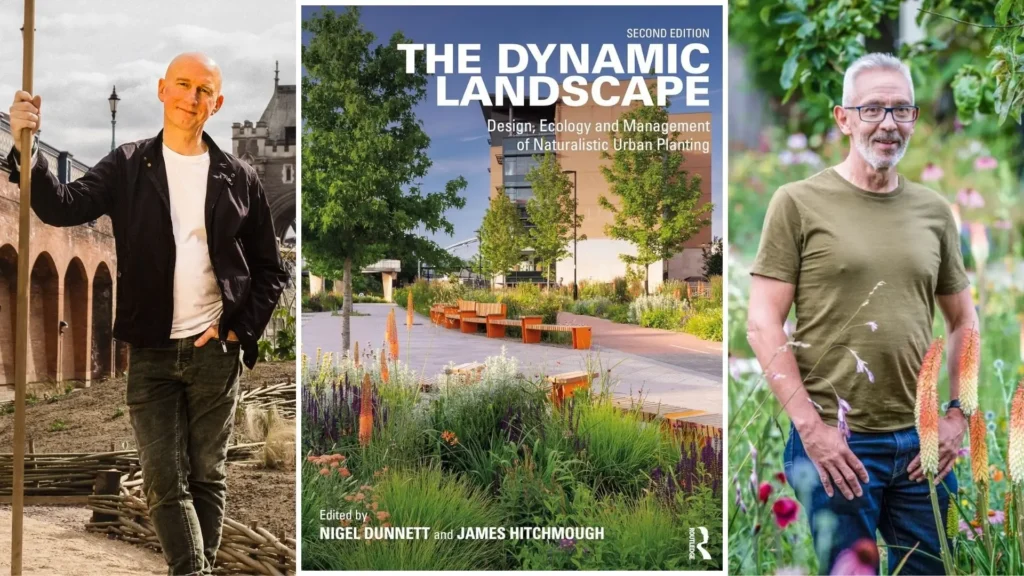
I leave you with an inspiring and exciting conversation between Nigel Dunnett and James Hitchmough, from the launch of the 2nd edition of The Dynamic Landscape: Design, Ecology and Maintenance of Urban Naturalistic Planting. Click the image for the recording, and enjoy this hour-long conversation, from autumn 2025.